
SEO for Real Estate SaaS: Complete Guide to Capturing Buyer Intent
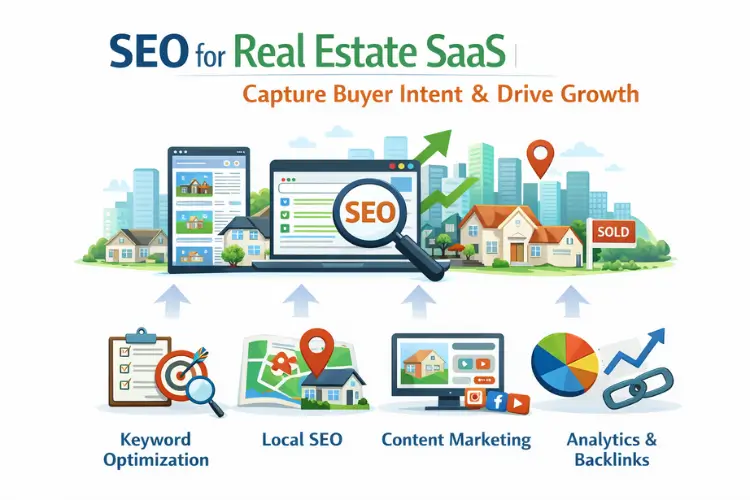
Real estate SaaS SEO works best when it lines up with how people actually make buying decisions. Some visitors are comparing software, some are trying to fix a workflow problem, and some just want a template or definition. When your pages match that intent clearly, rankings improve and leads get more qualified. The goal is simple: show up for the searches that signal real buying interest and make the path from query to demo feel natural.
1. Define buyer intent for real estate SaaS and what it changes in SEO
Buyer intent is the reason behind a search, and in real estate SaaS it usually ties to a job someone needs to do: generate leads, manage listings, follow up faster, improve agent productivity, or report performance. When you treat intent as the starting point, you stop chasing random traffic and start building pages that match purchase-ready questions.
1.1 Buyer intent vs curiosity searches
Curiosity searches sound informative, but they rarely lead to a demo. Examples are “what is a CRM” or “what is IDX,” where the user might be a student, a new agent, or someone browsing. Buyer intent searches are more specific, like “best CRM for real estate teams” or “IDX website builder pricing,” where the person is choosing a tool.
A practical way to separate the two is to look at how close the query is to a decision. If the search includes a role, use case, budget, or comparison, it often sits closer to buying. You can still write educational content, but your growth depends on capturing the moments when people are selecting software.
1.2 Map intent so it matches your product and it stays focused
A common mistake is writing one page to serve every type of visitor. A single “Real Estate CRM” page that tries to educate beginners, sell to teams, and rank for comparisons usually ends up unclear. Intent mapping keeps each page focused, so it answers one main reason someone searched.
Start by listing your main product outcomes, like “speed to lead,” “automated follow-up,” or “pipeline visibility.” Then connect each outcome to searches that show a need for that outcome. This is where it matters that your content matches the product experience, not just the keyword.
1.3 Identify the decision stages in real estate workflows
Most buyers move through a few stages even if they do it quickly. They first recognize a problem, then explore solutions, then compare vendors, and finally check trust signals like reviews, security, and integrations. Your SEO should cover each stage with the right page type.
For example, a problem-stage query might be “agents not following up leads.” A solution-stage query might be “real estate lead follow up automation.” A comparison-stage query might be “Follow Up Boss vs kvCORE.” If you only publish problem-stage blogs, you may build traffic but miss the decision-stage leads.
1.4 Build intent groups for buyers, agents, brokers, teams
Real estate SaaS has multiple audiences, and they do not search the same way. Agents search for personal productivity and lead flow, brokers search for reporting and adoption, and teams search for assignment rules and accountability. If you blend them, your message becomes generic.
Create intent groups by role and by company size. For instance, “CRM for solo realtors,” “CRM for real estate teams,” and “brokerage recruiting software” can be separate tracks. This helps you write pages that speak in the language of that buyer, including the metrics they care about.
1.5 Choose success metrics tied to pipelines
SEO metrics like impressions and clicks are useful, but they do not prove buyer intent by themselves. For real estate SaaS, the most meaningful measures connect to pipeline steps: demo requests, trial sign-ups, booked calls, and sales-qualified leads. You want to know which queries lead to revenue, not just visits.
Set up tracking so you can compare organic traffic by landing page against conversions. Even simple reports in your analytics can show patterns like “comparison pages convert 4x higher than glossary pages.” Once you see that, your content roadmap becomes much easier to prioritize.
1.6 Common intent traps in real estate SaaS
One trap is writing content that attracts consumers when you sell to professionals. A page targeting “how to buy a house” might bring huge traffic, but it will not produce CRM demos. Another trap is targeting “real estate software” broadly, which is too vague and often dominated by directories and big review sites.
A third trap is chasing keywords because competitors rank for them, even if they do not match your product. If you do not offer IDX, forcing IDX keywords into your plan creates misalignment and weak conversions. Intent-first planning keeps your SEO aligned with what you truly sell.
2. Build keyword research around intent signals and prove it with data
Keyword research for buyer intent is less about building a giant list and more about building a usable map. You want clusters that connect to product pages, use-case pages, comparison pages, and trust pages. Then you validate which clusters actually bring qualified leads, and you invest deeper where results show up.
2.1 Start with jobs-to-be-done queries
A strong approach is to collect queries that describe a job, not a feature. Instead of only chasing “real estate CRM,” look for “assign leads to agents,” “round robin lead distribution,” “track agent follow up,” or “open house lead capture app.” These searches often come from someone actively trying to solve a workflow issue.
Write down your product’s top workflows and turn each into a set of search phrases. This keeps your keyword list grounded in what buyers actually do. It also gives you natural language that you can use in headings and copy without forcing keywords.
2.2 Use modifiers that show readiness
Modifiers reveal how close someone is to purchasing. Words like “best,” “top,” “pricing,” “cost,” “demo,” “trial,” “reviews,” “alternatives,” “comparison,” and “integrations” usually signal higher intent. Role and scale modifiers like “for teams,” “for brokerages,” or “for 50 agents” can be just as strong.
You do not need to chase every modifier for every keyword. Instead, choose a few that match your buying cycle. If buyers often ask about integrations, build that track early. If pricing is a key question in sales calls, plan for pricing-related content that answers it clearly.
2.3 Build a keyword map to pages
A keyword map assigns each cluster to one primary page, so you do not end up with five pages competing for the same topic. For example, “real estate lead management software” might map to a solutions page, while “how to manage real estate leads” maps to an educational guide. They can internally link, but they should not be duplicates.
This also helps your writers stay consistent. When a page has a clear target, the structure becomes easier: define the problem, show the solution, support with proof, and guide the next step. You also avoid the slow SEO problem where you publish a lot but none of it consolidates authority.
2.4 Mine competitors without copying them
Competitor research is useful when you treat it as a discovery tool, not a template. Look at what competitors rank for, then ask why those queries exist and what the searcher expects to see. If a competitor ranks for “real estate ISA follow up scripts,” the intent might be training and process, not software.
Tools like Ahrefs or Semrush can help you spot keyword gaps and pages earning links, but you still need to decide if the intent fits your product. If you notice competitors ranking for “team accountability real estate CRM,” that can be a good signal that buyers search for management features. Then you can create a better page with clearer examples and outcomes.
2.5 Validate demand with Search Console and PPC data
Keyword tools estimate volume, but your own data is often more reliable. Google Search Console can show the real queries you already appear for and where you are close to page one. Sometimes the fastest wins come from improving a page that ranks 8 to 15 for a high-intent term.
If your company runs paid search, PPC data is another strong validator. Queries that convert on paid often convert on organic too, especially for comparison and pricing terms. You do not need huge budgets to learn from PPC, but you do need a habit of sharing learnings between teams.
2.6 Prioritize keywords by business value and ranking effort
Not every high-intent keyword is worth chasing first. Some are extremely competitive, and some convert poorly even if they seem strong. Prioritization becomes easier if you score keywords on two axes: business value and effort.
Business value can include deal size, lead quality, and sales cycle fit. Effort can include competition, content depth needed, and link strength required. A term like “CRM for real estate teams” might be harder but very valuable, while “open house lead capture app” might be easier and still bring qualified demos.
3. Information architecture for real estate SaaS sites that converts and ranks
Your site structure is part of SEO, not just design. It tells search engines what you are about and helps visitors find the right next step. A strong architecture for real estate SaaS usually combines product pages, solution pages, use-case pages, resources, comparisons, and trust content, all connected with intentional internal linking.
3.1 Product, solutions, and use-case pages roles
A product page explains what the product is and who it is for. A solutions page explains how you solve a problem like lead follow-up or agent accountability. A use-case page shows a workflow in context, like “lead routing for real estate teams” or “pipeline reporting for brokerages.”
Many sites blur these, and that creates confusion. If your “Solutions” page reads like a feature list, it does not match solution-intent searches. If your product page tries to cover every industry topic, it loses clarity. Each page type should have one job, and internal links should connect them.
3.2 Create a clear directory structure and internal links
A clean directory structure helps both crawling and user navigation. For example, keeping solutions under /solutions/ and comparisons under /compare/ makes it easier to scale content without chaos. It also helps you avoid random URL patterns that become hard to manage later.
Internal linking should be planned, not accidental. A solutions page should link to relevant use-case pages, a use-case page should link to the relevant product feature page, and all should link to a conversion path like “Request a demo.” This creates a logical funnel that also strengthens topical authority.
3.3 Build comparison and alternatives hubs
Comparison content often captures late-stage buyer intent. Instead of writing one-off comparison posts, build a small hub that includes “X vs Y,” “X alternatives,” and “best software for Z” pages. These pages should be honest, specific, and structured so readers can make a decision.
A simple example is a hub that links between “Best real estate CRMs for teams,” “Follow Up Boss alternatives,” and “kvCORE vs [your product].” Each page can answer different angles, but they should share consistent positioning and link to the same proof points and demos.
3.4 Local vs national considerations for SaaS
Real estate is local, but most SaaS products are not tied to one city. That can create confusion in content planning. In most cases, your SEO should focus on role, workflow, and software category, not neighborhood keywords. You can still support local relevance with examples, compliance notes, and regional workflows, but avoid pretending you are a local service provider.
If your SaaS includes marketplace partnerships, MLS coverage, or regional integrations, those can be legitimate topics. For instance, an “MLS coverage” page can be useful if it answers real questions buyers ask. Just keep it accurate and avoid creating thin location pages that do not add value.
3.5 Schema choices for SaaS and real estate content
Schema can help search engines understand your pages, especially for reviews, FAQs, product information, and articles. For SaaS, common schema types include SoftwareApplication, Product, FAQPage, and Organization, depending on what the page actually contains.
Use schema to clarify, not to manipulate. If you add FAQ schema, make sure the FAQs are on the page and genuinely helpful. If you publish comparison pages, structured headings and clear tables can help readers, even if schema does not guarantee special results.
3.6 Avoid thin pages and doorway patterns
It is tempting to create many pages for small keyword variations, like “CRM for agents,” “CRM for Realtors,” “CRM for real estate agents,” all saying the same thing. That usually hurts more than it helps, because pages compete and quality drops.
A better approach is to create one strong page that covers the concept well, then support it with deeper pages for distinct intents. If “CRM for teams” is different from “CRM for brokerages,” those can be separate. But if two pages would be nearly identical, consolidate and improve one instead.
4. Technical SEO for real estate SaaS sites that need clean crawling and fast pages
Technical SEO is the base that helps every other page perform better. If search engines cannot crawl your pages easily, or users hit slow loads and broken paths, even strong content will struggle. Real estate SaaS sites often grow fast and collect many pages, so small issues add up quickly. A steady technical routine keeps your site indexable, quick, and consistent as you publish more intent-focused pages.
4.1 Crawlability and index control for product-led sites
A real estate SaaS site often has marketing pages, docs, blog posts, templates, partner pages, and sometimes app subdomains. Crawling works best when you decide what should be indexed and what should stay out. Product and solution pages usually belong in search, while private app paths, staging URLs, and duplicate parameter pages usually do not.
Use robots.txt and meta robots carefully, and confirm decisions in Google Search Console. If a page is valuable for search, make sure it is not blocked by robots or stuck behind redirects. If a page is not meant to rank, keep it accessible for users but mark it as noindex so it does not dilute your focus.
4.2 Site speed focused on the pages that convert
Speed matters most on pages that attract buyer intent, like comparisons, pricing, and solutions. If those pages load slowly, users bounce before they read proof points or book a demo. For SaaS, slowdowns often come from heavy scripts, large images, and too many third-party widgets.
Start with simple fixes: compress images, lazy-load below-the-fold media, and reduce unnecessary scripts on key landing pages. If your team uses Core Web Vitals as a KPI, keep it tied to outcomes like demo conversions, not just scores. A “fast enough” site that converts well is more useful than chasing perfect numbers that do not change revenue.
4.3 Canonicals and duplicate content from similar pages
Real estate SaaS websites easily create near-duplicates, like multiple pages targeting “CRM for agents” and “CRM for Realtors.” Duplicate content can confuse search engines about which page to rank. Canonical tags help, but they are not a substitute for clear content decisions.
Pick one main page for each major intent and consolidate overlapping pages into it. Use canonical tags when duplicates are unavoidable, like UTM variations or sortable directories. Keep the page you want to rank internally linked more strongly than the duplicates so the signal stays clear.
4.4 JavaScript, rendering, and SEO for modern front-ends
Many SaaS sites use frameworks that rely heavily on JavaScript. Search engines can handle JavaScript better than before, but issues still happen if key content only appears after client-side rendering or requires user interaction. This is especially risky for pages that need to rank for buyer intent.
Test important pages with a fetch and render tool in Search Console and also by viewing the rendered HTML. If headings, body copy, and internal links are not present in the initial HTML, consider server-side rendering or static generation for marketing pages. Keep your content and navigation dependable even if scripts fail.
4.5 Auditing with a crawler and fixing patterns, not one-offs
A crawler makes technical SEO easier because it shows patterns across hundreds of URLs. Screaming Frog is one common tool teams use to find broken links, redirect chains, missing titles, and thin pages in a single scan. The goal is not to fix one page at a time, but to fix the root cause so issues stop repeating.
Schedule a monthly crawl and track a short list of checks: 404s, 3xx chains, pages blocked from indexing, duplicate titles, and missing canonical tags. If you fix one pattern each month, your site quality improves steadily without overwhelming your dev team. That consistency matters more than doing a big cleanup once a year.
4.6 Structured data, sitemaps, and trust signals for SaaS buyers
Sitemaps help search engines discover new pages, especially when you publish frequently. Keep your XML sitemap clean by including only indexable pages and updating it automatically. For real estate SaaS, you also want trust signals that search engines and users both recognize, like clear company info, support access, and transparent policies.
Structured data can support clarity on pages with FAQs, product details, and reviews, as long as those elements truly exist on the page. If you publish case studies, mark them clearly with consistent templates and strong internal links from relevant solution pages. This helps buyers validate fit quickly when they land from high-intent searches.
5. On-page SEO for product and solution pages that capture buyer intent
On-page SEO is where intent turns into clarity. A buyer-intent query expects a direct answer, not a general article. For real estate SaaS, the best on-page pages sound like a helpful salesperson who understands the workflow, but they read like a clean reference page that is easy to scan. Strong structure, specific language, and proof points help both rankings and conversions.
5.1 Titles and headings that match real buyer language
Your title tag should match the search intent and still sound natural. If the query is “CRM for real estate teams,” a title like “Real Estate CRM for Teams | Lead Routing and Follow-Up” stays clear and specific. Avoid clever wording that hides the category, because buyers often scan search results for direct matches.
Headings should follow the same logic. Use plain phrasing that mirrors how buyers describe the problem, like “Lead routing for teams” or “Pipeline reporting for brokers.” When headings match buyer words, readers feel they landed in the right place and stay longer.
5.2 Page layout that helps scanning and decision-making
Buyer-intent visitors scan first, then read. Your page should make the main points visible quickly: who it is for, what it solves, how it works, and what proof supports it. A simple layout beats a complex one, especially on mobile.
Use short sections, clear bullets, and direct subheadings. Add a short “how it works” block and an “ideal for” block so the buyer can self-qualify. Keep the demo or trial CTA visible, but place it naturally near sections that build confidence.
5.3 Writing product benefits without vague claims
Real estate SaaS pages often say “streamline your workflow” or “grow your business,” but those lines do not explain anything. Buyer intent searches need specifics, like “automate lead follow-up within 1 minute,” “assign leads by ZIP code,” or “track response time by agent.” Even if you avoid exact numbers, describe the outcome and the mechanism.
Try a simple pattern: problem, feature, result. For example, “When leads come from multiple sources, they get missed. Lead routing rules assign every lead instantly. Teams see faster response times and fewer dropped conversations.” That reads natural and still stays tied to intent.
5.4 Keyword placement that feels normal and not forced
You do not need to repeat a keyword many times. Use it in the title, one main heading, and a few natural places in the copy where it fits. Then use related terms that buyers expect, like “pipeline,” “lead sources,” “agent accountability,” “ISA,” and “broker dashboard,” depending on your product.
If you feel tempted to stuff phrases, write as if you are explaining the page to a broker who is busy. Clear language usually includes the right terms without trying. When your page reads well, it often performs better because users stay and engage, which supports your rankings.
5.5 Conversion elements that support SEO instead of competing with it
SEO pages should still convert, but conversion elements should match the intent. A comparison page can offer a “See a side-by-side demo,” while a solution page can offer “Get a routing rules walkthrough.” If the CTA feels aligned with what they searched, it increases conversions without feeling pushy.
Add social proof near the sections where buyers hesitate. A short customer quote about adoption, reporting, or response time can help, especially for broker and team buyers. Keep forms simple, and consider letting buyers choose “team size” or “role” so sales follow-up stays relevant.
5.6 On-page examples that make the product real
Examples reduce confusion and build trust. For a lead routing page, show a quick example like “Website leads go to round robin, Zillow leads go to ISAs, and open house QR leads go to the hosting agent.” That matches real workflows and helps buyers imagine setup.
For reporting pages, describe what a manager can see weekly, like “response time by agent, pipeline stage movement, and lead source performance.” The more your examples match daily operations, the more likely the page will capture buyer intent and convert after the click.
6. Content strategy that targets buyer intent keywords and supports the sales cycle
A real estate SaaS SEO strategy needs more than blog posts. It needs content that meets buyers at decision moments, answers objections, and shows fit in context. The most effective plans mix evergreen topics with high-intent pages like comparisons, integrations, and pricing explanations. When your content connects to product pages with smart linking, it becomes a pipeline asset instead of just traffic.
6.1 Use-case content built around real workflows
Use-case content works well because it sits between product pages and educational articles. A page like “Lead follow-up automation for real estate teams” can explain the workflow, the setup, and the result, without sounding like a generic blog post. These pages often rank for intent-driven queries because they match what the searcher wants.
Keep each use-case page narrow. For example, “open house lead capture” is different from “internet lead response” even though both involve leads. Narrow pages rank more easily and convert better because the buyer sees a direct match to their problem.
6.2 Comparison and alternatives content that stays honest
Comparison pages capture late-stage buyer intent, but they need careful writing. Buyers can tell when a page is unfair, and that reduces trust. A good comparison page explains who each tool fits best, where it is stronger, and where your product fits for certain teams.
Use a consistent structure: overview, key differences, feature comparison for the relevant workflow, setup and support, and pricing approach if you can share it. Add a short recommendation section like “best for teams that need strict routing rules” or “best for broker reporting.” Honest framing often performs better because it matches how buyers actually decide.
6.3 Integration pages that capture “connects with” intent
Many real estate SaaS buyers search for software plus their existing stack, like “CRM that integrates with Zillow” or “real estate CRM Mailchimp integration.” Integration pages can rank well because intent is clear and the searcher is already picturing implementation. These pages can also reduce sales friction by answering basic setup questions.
Each integration page should explain what the integration does, what data syncs, how to set it up at a high level, and common use cases. Include simple examples like “new lead from Facebook ads creates a contact and triggers a follow-up sequence.” Clear integration pages also help retention because customers find them later during setup.
6.4 Pricing and cost content that answers questions without hiding
Pricing is a high-intent topic, but many SaaS sites avoid it or keep it vague. You can still support buyer intent without publishing a full pricing table, if that is not your approach. A pricing page can explain how pricing is calculated, what plans include, and what affects cost, like team size or add-ons.
Add a section that answers common questions your sales team hears. For example, “Does pricing change by number of agents,” “Is onboarding included,” or “Do you charge for additional lead sources.” When you answer these clearly, you reduce back-and-forth and help serious buyers self-qualify.
6.5 Content that supports proof, trust, and adoption
Real estate SaaS buyers worry about adoption as much as features. Content that addresses onboarding, training, admin controls, and reporting can be surprisingly high intent. A broker searching “how to get agents to use a CRM” is often already evaluating tools and thinking about rollout.
Case studies and implementation stories work well here. Keep them specific with the before and after, the setup steps, and the results that matter like response time, appointments, and pipeline visibility. If you include numbers, make sure they are credible and explained, not just dropped in for impact.
6.6 Editorial planning using search data and sales call notes
Your best content ideas usually come from the questions buyers ask repeatedly. Collect those questions from sales calls, onboarding calls, and support tickets, then translate them into search-friendly topics. This creates content that feels natural because it comes from real conversations.
To prioritize, combine that list with your Search Console queries so you see what you already rank for and what needs improvement. For example, if you already appear for “lead routing rules” but rank on page two, a strong use-case page plus internal links might move it. That type of planning keeps your content tied to buyer intent outcomes.
7. Internal linking and topical authority for real estate SaaS SEO growth
Internal linking is one of the easiest ways to improve SEO without writing new pages. It helps search engines understand your site structure and helps buyers find relevant proof and next steps. For real estate SaaS, internal links also guide visitors from problem topics to solution pages, then to product pages and demos. When your links follow intent, your site feels organized and your rankings get stronger.
7.1 Build topic clusters around the problems you solve
A topic cluster is a group of pages that cover one problem deeply, with a strong central page. For example, a “Lead follow-up” cluster might include a solution page, an automation use-case page, templates for follow-up, an integration page for lead sources, and a comparison page. All pages link back to the central solution page, and that page links out to the deeper pages.
This structure helps search engines see you as relevant for the whole topic, not just one keyword. It also helps buyers because they can explore deeper without getting lost. When clusters are clear, you can add new pages over time without breaking the site structure.
7.2 Link from high-traffic pages to high-intent pages
Many SaaS sites have a few blog posts that bring the most traffic, but those visitors do not always see the product pages. A simple improvement is to add contextual links from those high-traffic posts to the right solution or use-case pages. The link should feel like a helpful next step, not a random CTA.
For example, if an article is about open houses, link to your “open house lead capture” use-case page with a short line about collecting leads into the CRM automatically. If an article is about response speed, link to your “speed to lead automation” page. These links move visitors toward buyer intent paths naturally.
7.3 Anchor text that stays descriptive and human
Anchor text should describe what the visitor will find, using natural phrasing. Instead of “click here,” use “lead routing for teams” or “pipeline reporting for brokerages.” This helps users and also gives search engines context about the linked page.
Do not over-optimize anchor text by repeating the exact keyword every time. Mix in variations that match real speech, like “team lead distribution,” “agent accountability reporting,” and “follow-up automation.” A natural anchor mix usually looks better and performs well over time.
7.4 Navigation links vs contextual links
Navigation links are important for discovery, but contextual links often carry more relevance because they sit inside content that explains the topic. Your main nav should include core categories like Product, Solutions, Pricing, and Resources. Then contextual links inside pages should connect the exact workflow to the exact next page.
For example, a solution page on lead management can link to an integration page for Zillow leads and a use-case page for ISAs. Those contextual links tell search engines and buyers that the pages are related. It also makes the site feel like it was built around real workflows, not just marketing sections.
7.5 Fix orphan pages and keep clusters complete
An orphan page is a page with few or no internal links pointing to it. Orphan pages tend to rank poorly because search engines and users rarely discover them. They also waste effort because you invested in writing and design but did not connect the page to the rest of the site.
A quick monthly check helps. Use a crawler report to find pages with very low inlinks, then add links from the most relevant pages in the same cluster. If the page does not belong in a cluster, that is a sign it might be off-topic or too thin, and you can merge it into a stronger page.
7.6 Link to conversion paths without forcing every page to sell
Not every page needs to push a demo aggressively, but every page should offer a reasonable next step. On high-intent pages, that step can be a demo or trial. On mid-intent pages, it might be a checklist, template, or short product walkthrough page that leads to a demo later.
A balanced approach helps SEO too, because users stay and explore more pages. If your internal links help buyers learn at their pace, you often see better engagement and more conversions. The site becomes easier to navigate, and the buyer intent traffic you earn turns into real pipeline more consistently.
8. Content quality signals for real estate SaaS SEO that builds trust and ranks
Search engines reward pages that feel genuinely useful, and real estate SaaS buyers also judge quickly whether a page is written by someone who understands the work. Content quality is not about sounding smart, it is about being clear, specific, and consistent. When your pages answer real questions with practical detail and show proof in a simple way, they tend to earn better engagement, more links, and better conversions from buyer intent traffic.
8.1 Write with real estate context, not generic SaaS language
Real estate teams and brokerages have routines that shape what they need from software, like lead response windows, handoffs between ISAs and agents, open house follow-up, and tracking by lead source. Content that mentions these naturally feels more trustworthy than generic wording. Even when the topic is broad, your examples should sound like they come from daily use.
A good test is to read a paragraph and ask if it could apply to any industry without changes. If it could, add one or two real estate details such as lead types, team roles, or common tools. This keeps your SEO pages aligned with buyer intent because the visitor sees their situation reflected in the copy.
8.2 Make your pages easy to verify with proof points
Buyer intent visitors look for reasons to believe. Proof can be customer quotes, specific workflow examples, screenshots, adoption details, or short case study highlights. You do not need to overload a page with claims, but you do need to support important statements with something concrete.
If you mention improved response time, explain what changed in the process, like automation triggers, routing rules, or reminders. If you mention better reporting, explain what a manager can review weekly. This style of proof helps both SEO and sales because visitors can understand your value without guessing.
8.3 Keep content updated so it stays accurate and competitive
Real estate SaaS changes through new integrations, UI updates, and pricing shifts, and search results also change as competitors publish new content. If your highest intent pages become outdated, they slowly lose rankings and conversion power. A simple update rhythm helps you protect wins.
Review your top organic landing pages each quarter and refresh the parts that age, like feature descriptions, integration steps, or screenshots. Even small updates, like adding a new FAQ or clarifying a setup step, can help rankings because it improves relevance and user experience.
8.4 Use helpful tools to support quality checks
A basic content checklist is easier when you use tools that show what is missing. SurferSEO can help compare your page structure and topic coverage against what currently ranks, and it can highlight gaps in related terms without forcing you into keyword stuffing. It is most useful as a review tool, not as a writing rulebook.
For clarity and consistency, even a simple grammar tool can catch rough phrasing, but the main quality signal is still human readability. If the page sounds like a real person explaining a workflow to a broker, it is usually in good shape. Keep tools in a supporting role and let real customer questions guide your edits.
8.5 Avoid filler sections that weaken buyer intent pages
Many SaaS pages add long history lessons or generic definitions to increase word count. That often hurts because buyer intent visitors want direct answers and clear fit. If a section does not help someone decide or implement, it probably belongs in a separate educational article.
Instead, use your space for decision-making details: who it fits, how it works, what it integrates with, what setup looks like, and what results to expect. This keeps pages focused, improves engagement, and makes it more likely that the visitor takes the next step.
8.6 Build author credibility and company trust signals
Trust is not only content, it is presentation and transparency. Clear author names, role context, and company details help. If you can include a short “reviewed by” note from a product expert or implementation lead, that often improves how the content feels, especially for broker buyers.
Also make sure your site has easy-to-find support details, privacy policy, security information, and a real company presence. Buyer intent visitors may open multiple tabs and compare credibility signals quickly. Simple trust elements can make the difference between a demo request and a bounce.
9. Link building and partnerships for real estate SaaS without spam tactics
Links still matter in SEO because they act like trust signals from other sites. For real estate SaaS, link building works best when it comes from genuine partnerships, useful resources, and content people want to reference. The goal is not to chase random backlinks, it is to earn links that support the topics you want to rank for, especially the buyer intent categories.
9.1 Earn links with resources teams actually use
Real estate professionals share practical resources, like scripts, checklists, calculators, and templates. When you publish resources that solve common problems, other sites are more likely to reference them. A lead follow-up checklist, an open house QR setup guide, or an ISA handoff script pack can earn links naturally if it is genuinely useful.
Keep these resources tied to your product outcomes without making them ads. A resource can be helpful on its own and still include a simple note about how software automation supports the workflow. That balance makes it linkable and still relevant to buyer intent.
9.2 Partner with associations, communities, and education platforms
Real estate has many communities, from team owner groups to brokerage coaching networks. Partnerships can lead to mentions, guest content, webinars, and resource swaps that result in high-quality links. The best partnerships are the ones where your content helps their audience and their audience fits your product.
Focus on relationships that align with your buyers, like team leader communities or brokerage operations groups. A single link from a respected community page or resource library can be more valuable than dozens of random directory links. It also tends to send qualified traffic because the audience is already in the market.
9.3 Use integration partners as a link and traffic channel
Integration partners are a natural link source because you share customers. If you integrate with a lead source, dialer, email tool, or marketing platform, create a joint integration page strategy. Your site can publish a detailed integration guide, and the partner can list your integration in their directory or help center.
This works well for buyer intent because many integration searches are late-stage. Someone searching “CRM that integrates with X” is often already shopping. Partner links also tend to be durable because they are tied to product documentation, not temporary campaigns.
9.4 Digital PR that fits real estate SaaS
Digital PR does not need big stunts. In real estate SaaS, simple data stories can work if they are true and useful, like trends in response time, lead source performance, or follow-up frequency across anonymized users. If you publish a short annual report or quarterly insights page, it can attract references from blogs and newsletters.
Keep the data honest and easy to explain. Use small charts and clear takeaways, and add context so readers do not misinterpret it. If the insights are practical, you can earn links while also building authority around buyer intent topics like lead management and team performance.
9.5 Avoid low-quality directories and paid link traps
Real estate has many software lists and directories, and some are fine, but many exist mainly to sell placements. Low-quality links can waste budget and sometimes create risk. A good rule is to ask whether a directory sends real traffic and whether it is recognized by your buyers.
Prioritize review sites and directories that buyers actually use during evaluation, but keep expectations realistic. You may not outrank major review sites for every “best” keyword, but you can still win with comparison pages, niche use-case pages, and strong brand searches created by good content and partnerships.
9.6 Measure link building by rankings and pipeline, not link counts
Counting links is not enough. Measure whether links improve rankings for the buyer intent terms you care about and whether those pages generate demos. Track a small set of target keywords and the landing pages mapped to them, then watch how those pages move over time.
Also pay attention to assisted conversions. A buyer might first land on a resource page, then return later through a comparison search and convert. When you connect link efforts to page performance and pipeline, you keep link building grounded in outcomes, not vanity numbers.
10. Conversion-focused SEO for real estate SaaS that turns rankings into demos
Ranking for buyer intent is only half the job. The page must also help the visitor take a next step that matches their intent. Conversion-focused SEO is about removing friction and helping buyers self-qualify with clear information. For real estate SaaS, that usually means guiding visitors from search to a confident demo request, without making the page feel like a sales trap.
10.1 Match CTAs to the search intent level
A visitor coming from “best real estate CRM for teams” might be ready for a demo, while a visitor coming from “real estate lead routing rules” might want to understand the concept first. If you push the same CTA everywhere, conversions often suffer. CTAs work best when they feel like the natural next step for that query.
On high intent pages, use direct CTAs like “Request a demo” or “See pricing options.” On mid intent pages, offer a “Watch a 3-minute walkthrough” or “Get a lead routing checklist” that still leads into a demo later. The page stays helpful and still supports pipeline growth.
10.2 Use short forms and smart routing for leads
Long forms reduce conversions, especially on mobile. Keep forms short and collect only what you need for routing, like name, email, company, and team size. You can gather more details later in the sales process. The key is to make the next step easy.
If you have multiple buyer types, route them based on role or team size so the follow-up feels relevant. For example, a broker lead should get content about reporting and adoption, while an agent lead might want productivity and lead flow. When the next step feels personal, SEO traffic converts better.
10.3 Add friction reducers that answer common objections
Buyers hesitate for predictable reasons: setup time, agent adoption, integrations, and support quality. Add sections that address these clearly. A short onboarding overview, an integration list, and a support promise with real details can reduce hesitation.
Include a simple “What setup looks like” section that explains steps, even at a high level, like connecting lead sources, setting routing rules, and enabling follow-up sequences. When buyers understand the path, they are more likely to book a demo because the unknown feels smaller.
10.4 Use case studies and examples where buyers get stuck
Case studies work best when they show a situation the buyer recognizes. For real estate SaaS, that might be a team missing leads, a brokerage lacking reporting, or agents not following up consistently. A short story with a clear before and after helps buyers believe it can work for them too.
Place case studies on pages where intent is high. A comparison page can include a short “why teams switch” section with a quote. A solution page can include a mini case study about implementation. Keep it short and specific so it supports the decision rather than distracting.
10.5 Test SEO landing pages with small experiments
You do not need complex experiments to improve conversion. Test one change at a time on high-traffic buyer intent pages, like headline clarity, CTA wording, or moving proof points higher. Even small changes can increase demo rate without affecting rankings.
Use tools like Microsoft Clarity for session recordings and heatmaps to understand where users scroll and where they drop off. This can reveal simple fixes, like a confusing section title or a missing internal link to pricing. When you pair behavior insights with SEO data, optimization becomes straightforward.
10.6 Measure conversion by landing page and query group
Conversion measurement improves when you group pages by intent type. Compare conversion rates across solution pages, comparison pages, integration pages, and educational posts. You will usually see that buyer intent pages convert higher, and that tells you where to invest.
Also watch assisted impact. Some pages support conversions later even if they do not convert immediately. When you build dashboards that show both direct and assisted conversions from organic traffic, you can justify content that builds trust and still supports pipeline.
11. Reporting, iteration, and scaling buyer intent SEO in real estate SaaS
SEO in real estate SaaS improves when you treat it like a loop: publish, measure, update, and expand what works. Buyer intent pages give clearer feedback because you can tie them to demos and revenue. Over time, you build a system where every new page fits a cluster, supports conversions, and strengthens authority. This makes growth more predictable and less dependent on one-off wins.
11.1 Set up reporting that sales and marketing both trust
SEO reporting often fails when it stays only in marketing metrics. Build reports that show organic traffic by landing page, conversions by landing page, and pipeline influence. If sales can see that certain pages bring better leads, they support the strategy and share better insights.
Use Search Console for rankings and query data, analytics for conversion paths, and CRM reporting for deal outcomes. Even a simple monthly report that connects top landing pages to demo requests can keep everyone aligned. The goal is to make SEO visible as a pipeline channel, not just a traffic channel.
11.2 Create a refresh cycle for your highest intent pages
High intent pages deserve ongoing attention because they are closest to revenue. Set a refresh schedule, like every 90 days, to review top pages for ranking changes, new competitor pages, and new product updates. Small improvements can protect your rankings and increase conversions at the same time.
Refresh work can include adding new FAQs, improving examples, updating screenshots, or adding a new internal link section. Keep a change log so you can see what updates correlate with ranking improvements. Over time you learn what moves the needle for your niche.
11.3 Scale with templates without making pages feel copied
Templates help you scale pages like integration pages, comparison pages, and use-case pages. The risk is that pages start feeling identical, which reduces quality and can limit performance. The best approach is to standardize structure but customize the details heavily.
For example, an integration template can always include “what it does,” “setup steps,” and “common workflows,” but each page should have examples specific to that integration. A comparison template can include the same categories, but the differences should be specific and fair. When templates keep you consistent and customization keeps you real, scaling stays safe.
11.4 Align SEO with product releases and roadmap priorities
Product updates create natural SEO opportunities, especially when they improve a workflow buyers search for. If you launch new routing rules, reporting dashboards, or new integrations, publish pages that explain them in plain language. This helps existing users and also attracts buyer intent searches tied to those features.
Create a simple process where product and SEO teams share release notes early. Then your SEO content can ship close to the release, when interest is highest. This also keeps your content accurate because it reflects what the product actually does right now.
11.5 Handle competitive shifts and SERP changes
Search results change as competitors invest and as Google adjusts layouts. Some keywords become more directory-heavy, some become more video-heavy, and some shift toward comparison content. You can adapt by reviewing the pages that currently rank and matching what the searcher expects to see.
If SERPs for a keyword show mostly comparisons, your solution page may not rank well until you build a comparison page. If SERPs show guides, a product page might need supporting content and links. Regular SERP reviews help you keep intent alignment as the market changes.
11.6 Build a long-term moat with topic depth and brand demand
A long-term SEO advantage comes from owning a topic deeply and being recognized as a trusted option. Topic depth means your site covers the workflows buyers care about with strong pages that link together. Brand demand means buyers search for you by name because they have heard of you and trust you.
You can build brand demand by publishing genuinely helpful resources, showing up in communities, and earning mentions through partnerships and integrations. Over time, SEO becomes easier because your pages perform better and buyers click your results more often. That is when buyer intent SEO starts to feel like a steady pipeline channel.