The Complete B2B SEO Guide for Better Leads and Long Term Growth
B2B SEO can feel confusing at first. A lot of advice online talks about traffic, rankings, and content volume, but B2B search does not work in such a simple way. Most buyers do not search once, land on a page, and buy right away. They take time, compare options, check trust, and involve other people inside the company. In many cases, they leave, come back later, and revisit the same business after a week, a month, or even longer.
That is why this guide matters.
This is a practical B2B SEO guide built for long buying cycles, buying committees, and multi stakeholder decisions. It is not written for random traffic growth. The goal is to help businesses use search to bring better leads, more serious conversations, and stronger pipeline.
When a B2B website gets visits but not good leads, the problem is often bigger than rankings alone. Usually, the real issue is that the website does not match how B2B buyers actually think and search. A company may rank for broad keywords, but those visits will not turn into demos or inquiries if the pages do not answer the right questions at the right stage.
This guide covers discovery, evaluation, and shortlist stages. It explains how to map search intent to solution pages and comparison pages. You will also see why good B2B SEO should measure more than traffic. Most importantly, this approach works for SaaS, services, and industrial B2B businesses because the core idea stays the same. Search should support the real buying journey.
Why B2B SEO is Different
B2B SEO is different because B2B buying is different.
In many consumer industries, a buyer is often just one person. That person has a need, looks for an answer, compares a few options, and chooses one. In B2B, the story is usually more complex. A manager may discover the need. A team member may research options. A decision maker may review pricing. Someone from operations or IT may check implementation. Finance may ask about cost and return. The final decision can involve several people, and each one may have different questions.
That changes everything.
A B2B website cannot be built only for search engines. It also has to work for real people at different stages. One page may need to explain the problem clearly. Another may need to show use cases. A different page may compare features. Some pages may need to reduce risk with trust signals, process details, or proof.
That is why B2B SEO is not just about publishing more blogs. The real goal is to create the right set of pages that helps buyers move from curiosity to confidence.
When SEO is done well for B2B, three things improve together. Visibility gets stronger, trust grows, and the path from search to inquiry becomes much clearer.
The Three Main Stages of the B2B Search Journey
To build the right SEO strategy, it helps to understand the three main stages most B2B buyers move through.
Discovery Stage

This is the early stage. At this point, the buyer knows there is a problem but may not be ready to pick a vendor yet. They are trying to understand what is wrong, what solutions exist, and what kind of approach makes sense.
Searches are often broader here. A person may look for the problem, a method, a category, or a use case. In many situations, they may not even know which type of service or software they need.
That is where educational content becomes important. Guides, problem solving pages, category explanations, and use case pages can all help. The goal is not only to bring traffic. What matters more is helping the right buyer feel, “Yes, this is the kind of solution I need to look at.”
A weak site often stops here. It creates top of funnel content, gets some visits, and feels busy. Even so, that traffic stays shallow when the site does not guide the visitor toward deeper pages.
Evaluation Stage
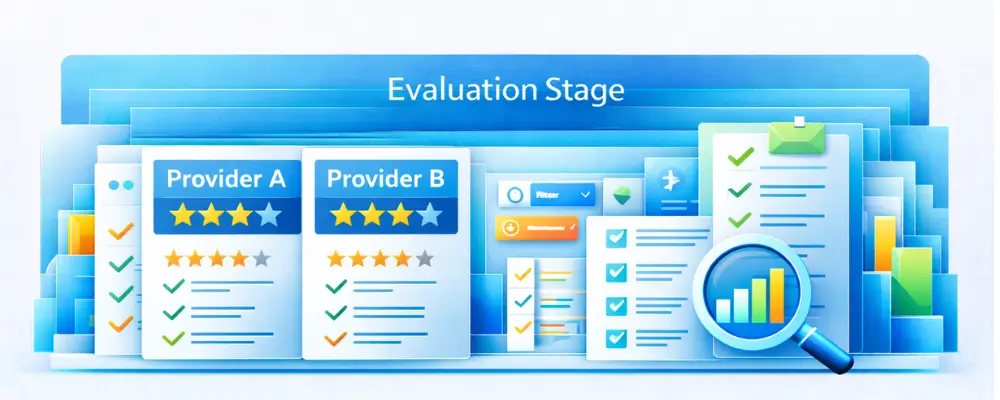
This is where things get more serious.
By now, the buyer usually knows the type of solution they want. They are comparing providers, features, approaches, or fit. Their searches may include service pages, solution pages, industry specific pages, or pages that explain how the offer works.
This stage is very important for B2B SEO because many high intent keywords live here. A buyer may search for a specific kind of B2B SEO service, a software solution for their industry, or a provider that solves a clear business problem.
Intent mapping becomes powerful at this point. If the buyer is evaluating options, a vague blog post is rarely enough. They should land on a page built for decision support. The page should clearly explain the offer, the outcome, the process, and why it fits.
Shortlist Stage

This is the final stage before action.
At this point, the buyer is close to reaching out. They are narrowing down options and reducing risk. Their searches may include comparison pages, alternatives pages, pricing explainers, implementation details, case studies, reviews, or trust content.
These searches are often the most valuable because the person is closer to a sales conversation. Still, many websites ignore this stage. Some do not build these pages at all, while others build them poorly.
A strong B2B site supports the shortlist stage with pages that answer difficult but important questions. What makes this service different? What happens after signup? How long does onboarding take? What results have similar clients seen? What is included? Why is the pricing structured this way?
Those questions matter because B2B buyers do not just want to know what a business sells. They also want to know what happens next.
Why Intent Mapping Matters So Much
Intent mapping sounds technical, but the idea is simple.
It means matching the right keyword to the right page.
If someone is looking for general information, a guide or explainer page may work well. When someone is comparing providers, a comparison page is usually better. If a person is looking for a service in a serious way, the service page should be the main target.
Many B2B sites make a common mistake here. Some target strong commercial keywords with weak informational pages. Others target informational keywords with sales pages that feel too early. This mismatch hurts both ranking and conversion.
A good B2B SEO strategy maps discovery keywords to educational pages, evaluation keywords to solution and service pages, and shortlist keywords to high trust decision pages like alternatives, pricing, case studies, and proof content.
When this mapping is done correctly, search traffic feels more qualified because the page matches the visitor’s real mindset.
The Pages Every Good B2B SEO Strategy Needs
A strong B2B SEO setup usually includes a mix of page types, not just one.
Service and solution pages matter because they connect search with the actual offer. These pages should clearly explain what the business does, who it helps, and what outcome it creates.
Industry pages matter because buyers often want to know if a provider understands their field. A general page may not be enough for someone in SaaS, manufacturing, healthcare, logistics, or finance. Well built industry pages help create relevance and trust.
Comparison and alternatives pages matter because buyers often compare options before they reach out. These pages should be honest, useful, and written for real decisions, not just for clicks.
Pricing explainers matter because uncertainty around pricing creates friction. Even when exact prices are not listed, buyers still want to understand how cost works, what affects price, and what kind of investment to expect.
Case studies matter because they turn claims into proof. A good case study does not only talk about growth. It should also explain the starting point, the work done, and the business outcome.
Implementation and process pages matter because B2B buyers want clarity. They want to know how the work will start, what support looks like, and what the early months may involve.
Trust pages matter too. These can include certifications, team experience, tools used, client results, and clear explanations that reduce risk.
B2B SEO Is Not Just Content
A lot of people think SEO means writing articles. That idea is too small.
Content is important, but B2B SEO also depends on structure, clarity, and technical health.
If key pages are buried deep inside the site, search engines may not treat them as important. Weak internal linking can also stop authority from flowing well. On top of that, crawl issues, slow pages, duplicate content, or confusing structure can make even strong content struggle.
Technical SEO helps search engines understand the site clearly. It supports indexing, page priority, site architecture, and content relationships. In B2B, this matters because many sites grow over time and become messy. New service pages, blog posts, location pages, and landing pages often get added without a clean plan.
Good technical SEO brings order. It helps search engines and users move through the site in a more logical way.
Why Pipeline Metrics Matter More Than Traffic
This is one of the biggest truths in B2B SEO.
Traffic is useful, but traffic alone does not pay the bills.
A page can get thousands of visits and still bring weak results if the visitors are not the right people. On the other hand, a page with lower traffic can become very valuable when it consistently brings qualified leads.
That is why B2B SEO should measure more than sessions and rankings. It should also look at things like demo requests, form quality, inquiry rate, keyword group performance, landing page quality, and how search supports sales conversations.
This does not mean traffic has no value. It simply means traffic should be judged by what it leads to.
A B2B company should ask practical questions. It needs to understand which pages bring serious inquiries, which keywords attract real buyers instead of casual researchers, and which content supports later conversion. It is also important to see which pages reduce friction and help deals move forward.
When SEO is measured this way, the strategy becomes smarter. Decisions become clearer, content gets better, and the team stops chasing vanity numbers.
How This Works for SaaS, Services, and Industrial B2B
Some people think B2B SEO is only for software companies. That is not true.
It works for SaaS because SaaS buyers search in stages. They look for categories, use cases, alternatives, integrations, pricing, and implementation details. A clear SEO strategy helps move those buyers toward trials, demos, or sales calls.
It also works for service businesses because service buyers search for problems, providers, methods, and trust. They want to know if the team understands their challenge and can deliver the result. SEO helps bring those buyers to the right pages with the right message.
Industrial B2B can benefit too. Buyers in these industries also research seriously before reaching out. They may search for technical solutions, product applications, supplier options, process details, or distributor support. In these cases, clear pages with real proof can make a huge difference.
The wording may change across these business types, but the deeper pattern stays the same. Buyers move through discovery, evaluation, and shortlist stages. The job of SEO is to support those stages clearly.
What a Good B2B SEO Plan Looks Like in Real Life
A good B2B SEO plan usually starts with understanding the business, not with random keyword tools.
The first step is getting clear about the ideal buyer. This means understanding who the real target is, what problem they are trying to solve, the kind of language they use, and which outcome matters most to them.
After that comes the keyword and page map. This is where search demand gets connected to real page types. The team identifies which service pages need improvement, which missing pages should be created, and which keyword groups belong to which stage.
Then comes execution. Existing pages get improved. Weak pages get stronger structure. Missing pages get created. Internal linking gets better. Trust signals get added. Technical issues get fixed. Tracking becomes more useful.
The next step is iteration. SEO is not something a team does once and forgets. It gets stronger when pages are reviewed, performance is studied, and the next round of work is based on what buyers are actually responding to.
Common Mistakes That Hurt B2B SEO
Many B2B sites make similar mistakes.
Some create too much general content and not enough commercial content. Others write service pages that are too vague to rank and too weak to convert. Many ignore comparison and shortlist content. A few measure only traffic and feel disappointed when leads do not improve. In some cases, businesses build good content but never fix the technical or structural issues holding the site back.
Another common mistake is trying to sound clever instead of clear. In B2B, clarity wins. Buyers are already dealing with enough noise. They do not want fluffy writing. They want direct answers, strong structure, and proof they can trust.
Final Thoughts
B2B SEO works best when it is treated like a growth system, not just a content task.
A strong approach should support discovery, evaluation, and shortlist stages. It should map intent to the right pages. Good SEO should also measure pipeline, not just traffic. Most importantly, it should be built in a way that works for real businesses, whether they sell software, services, or industrial solutions.
If there is one thing to remember from this guide, it is this. Good B2B SEO is not about getting more visitors at any cost. It is about helping the right people find the right page at the right moment, then giving them enough clarity and trust to take the next step.
That is how search stops being just a visibility channel and starts becoming a serious source of business growth.
A strong B2B SEO strategy does not shout. It does not chase empty numbers. Instead, it quietly builds the path from search to trust, from trust to inquiry, and from inquiry to real pipeline.
And in B2B, that quiet work is often what creates the biggest results.